


First, a quick commercial break: Organizations get a 40% discount when they register five or more employees for a paid subscription to Williamsburg Watch. Sign up here.
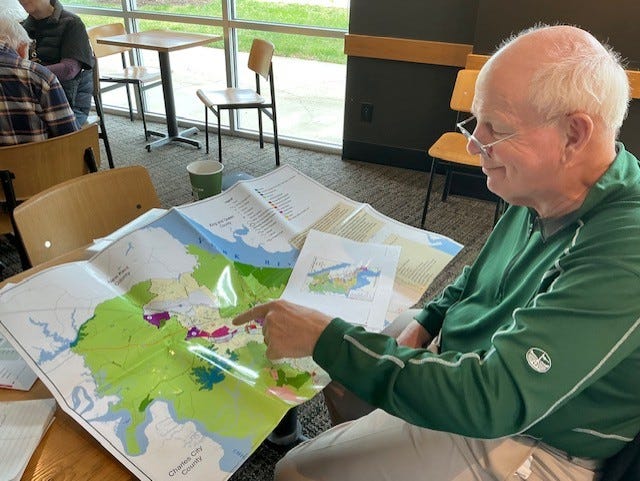
Jack Haldeman worries about the cumulative impact of James City County’s growth, and the gap between what its citizens say they want and what is happening.
The first land use plan developed more than 50 years ago set James City “on a path toward becoming a crowded, automobile-dependent, racially and economically homogenous, environmentally-impaired exurb of Newport News and Richmond.” , the former Chair of the county planning commission member told the Board of Supervisors in a New Year’s email.
Besides jammed roadways, the growth raises the cost of county government, endangers the county’s watersheds and makes it harder to retain the rural character that residents want, we were told by Haldeman, who first joined the planning commission in 2017.
Haldeman said there is a fundamental disconnect between the vision for development in the county’s comprehensive use plan, which is an aspirational document, and the sorts of projects being approved in bits and pieces.
More than 95% of county residents surveyed by the University of Virginia in 2019 said maintaining environmental quality was important, 97.5% wanted good roads, and 85.2% wanted to maintain the county’s rural character.
But since the land use map was drawn up in 1975, the county’s population has grown from 15,000 to more than 80,000 residents, according to U.S. Census projections.
Paving over land to house them has impacted the entire Powhatan Creek watershed that dumps pollutants into the James River, from which it flows into the Chesapeake Bay.
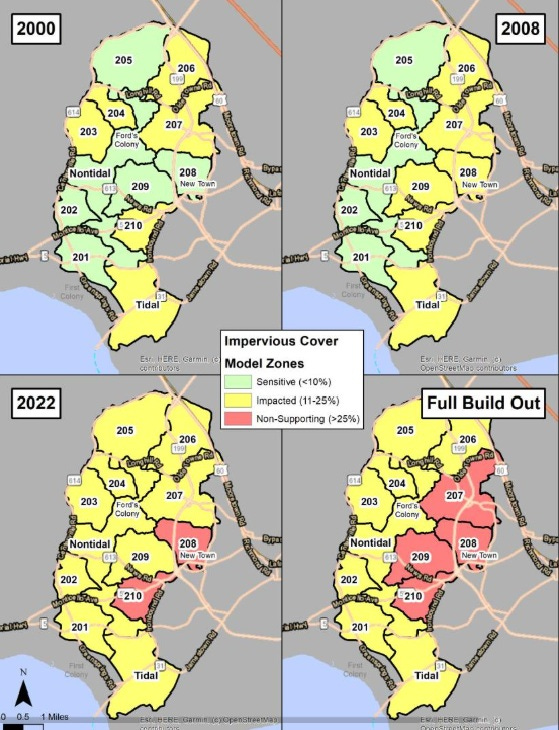
In the next month, the supervisors will be looking at proposals for new development that would add more than 1,700 homes to the mix. Combined with other approved housing, nearly 3,000 more houses could be built in the next five to eight years, Haldeman warns.
Haldeman says any one of the new developments might meet county criteria for impact on roads and the environment.
But the cumulative impact is dramatic, he said, leading to more than 50,000 additional daily car trips on local roads, with no room to widen critical intersections.
He is aware of the irony that he is criticizing unrestrained growth when he himself transplanted to James City County from the New York area 21 years ago.
“People point out to me, you know, you’re part of the problem,” Haldeman said wryly. “They’re absolutely right.”
Haldeman said he and his wife had been visiting the Williamsburg area for decades before they purchased a lot to build a house in Governor’s Land in 1988.
By the time they moved here 20 years ago, the county had already changed quite a bit, with shopping centers and housing developments on what used to be farmland.
“We kind of went, whoa, what is going on here? I mean, this is country. None of this stuff existed” when they first started visiting, said Haldeman, who retired from the financial services industry.
The lack of affordable working-class housing is a constant complaint in the county.
But Haldeman said the county should focus on helping local residents with conversion of existing buildings, like the Fort McGruder hotel, or the county’s evolving land trust program, rather than too many new developments.
“Are we...providing affordable housing for people from Newport News, or are we providing newer affordable housing for people who are... James City County residents and work here?” Haldeman asked rhetorically. “The examples are always given of our starting entry level teachers, police officers, firemen. Is that who we’re doing affordable housing for? I mean, there’s only so many teachers to go around here. And there’s not a lot of jobs.”
Haldeman said most of the new housing developments planned in the northern part of the county will appeal to well-paid commuters who can hop onto 64 and quickly drive to jobs in Richmond: “You can live in Stonehouse. Good schools, no crime. 83 cent tax rate. Beautiful amenities, parks and recreation... Or you can live in Richmond, high crime, high taxes, dysfunctional schools.”
Haldeman said the county passed up an opportunity to buy the surplus Eastern State land where two developments with more than 1,000 homes are being planned.
But he praised the county supervisors for taking other steps to restrict development in agricultural areas, and ensuring they only approve houses on the developable part of a tract, rather than allowing developers to add more houses by including parts of the parcel that cannot be used for homes.