
Bus ridership growing, but needs more frequency, regional system head says
Good morning, Today we'll talk WATA ridership, tell you why housing advocates say our area needs denser housing, and publish a warning about density from the James City County planning chair.
Correction: we have corrected the name of WATA in the second paragraph.
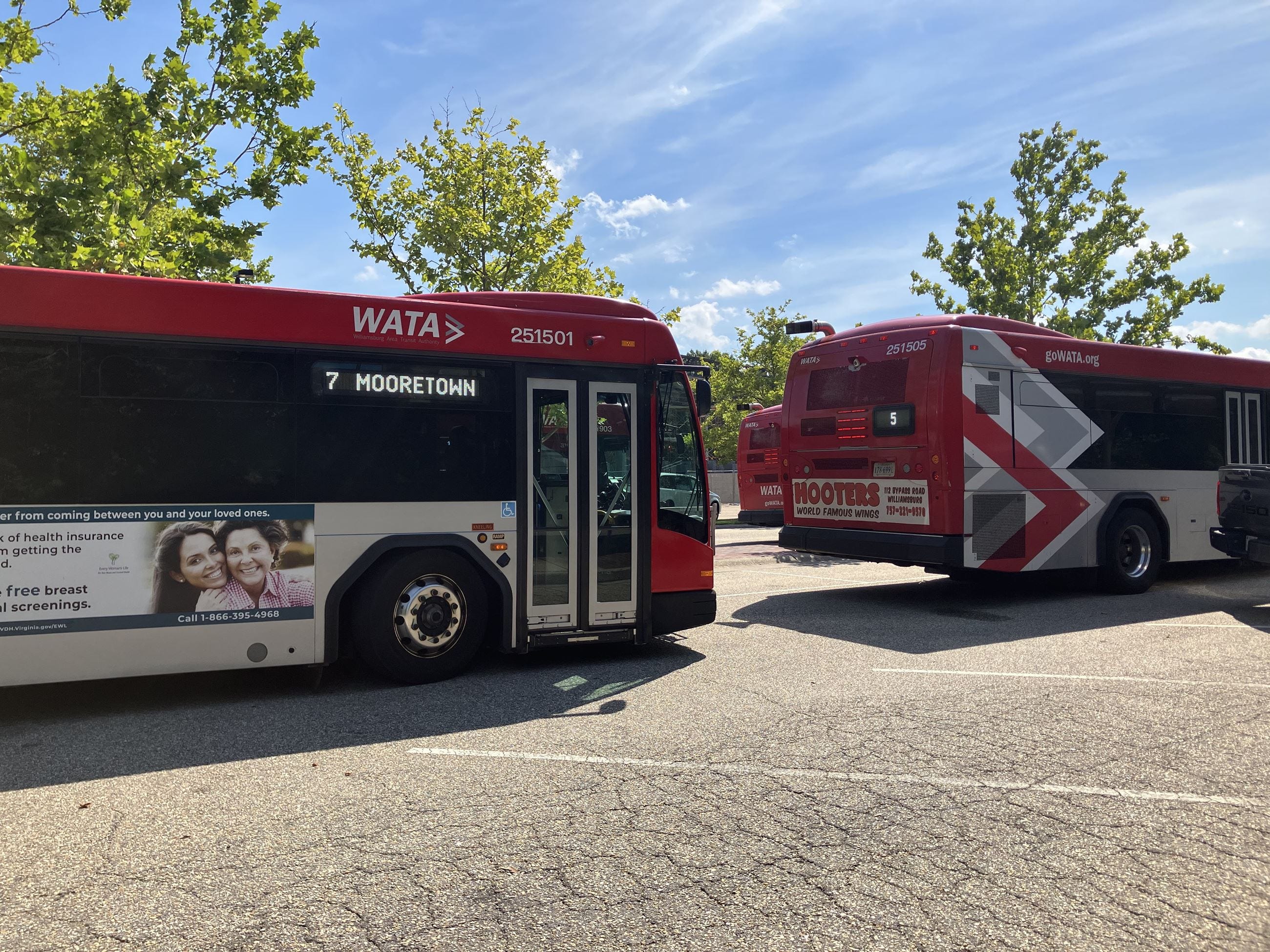
The regional bus authority reached a post-Covid high of 1.5 million riders last year and will increase frequency to be a more convenient option, Williamsburg City Council was told Monday.
“We need to be more convenient” to grow ridership further, Matthew Scalia, executive director of the Williamsburg Area Transit Authority, told the council’s work session.
Scalia said frequency on the two main routes – 1 from Lee Hall to the Williamsburg Transportation Center and Route 2 along the Richmond Road corridor– will increase to every 30 minutes this spring. Other routes will get additional frequency over the next four years, he said with Route 12 going to a bus every 15 minutes.
Increased ridership will eventually increase the federal funding that pays 41.6% of the bus service’s $9.8 million operating budget this year, Scalia said. Localities served by WATA -- Williamsburg and James City and York counties – contribute 15.7%. The balance is paid by a combination of state funding, payments from Colonial Williamsburg and fares.
Scalia told city council bus riders will benefit from the August opening of the new $11 million transit center off Mooretown Rd near the Sentara Williamsburg Regional Medical Center.
The new center will feature public restrooms and both indoors and outdoor shelter spaces that will make changing buses more comfortable and safer, Scalia said.
It will replace an external stop near the Walmart.
Supply and demand key to controlling home prices, affordability advocates say.
The only way to slow the cost of housing in our area, affordable housing advocates say, is to allow the economic law of supply and demand to work. That means scrapping the cumbersome process of special use permits, allowing more housing density, and getting over outdated prejudices about manufactured housing and multifamily housing.
Housing prices have shot up in the past two decades not because of greedy developers or wicked landlords, but because politicians have artificially constrained supply, they say.
Contrasting approaches between twin cities Minneapolis and St. Paul provides a real-life example, The Wall Street Journal reported last month: St. Paul enacted one of the nation’s strictest rent control programs and saw apartment growth drop 79% while rents increased at the 3 percent maximum each year. Minneapolis focused on new housing by removing restrictions on apartments and saw a boom in downtown apartments that attracted young professionals with annual rent inflation of less than 1% from 2022 to 2024, according to the CoStar real estate data company.
“Localities need to get more comfortable with more density,” we were told by Bob Adams, a housing advocate who has been appointed to a transition team for housing policy in incoming Gov. Abigail Spanberger’s administration.
Our local communities favor large single-family homes on large tracts of land, which makes housing more expensive, Adams said.
“The cost of land under the house is more expensive and increases the cost of the infrastructure to support that house-- A lot more road, more water line, more sewer line, etc. “ he said.
Local politicians are often intimidated by the phenomenon of NiMBY – Not In My Back Yard.
People who moved to James City County for its more rural nature tend to come out swinging against more housing projects, and that scares the elected officials, housing advocates said.
Opponents complain multifamily projects will further clog roads and generate crime.
“A lot of that, to be quite frank, is tied to racism, its tied to classism,,” said Eric Mai of Housing Forward Virginia, a nonpartisan group that is part of a nationwide policy push for more affordable housing. “People automatically think (affordable housing) is going to create crime increases...there’s been a lot of research done that shows that that’s not true. That still is a very prevalent perspective that people hold.”
We spoke to George Tia at the University of California – Irvine, who has studied the impact of denser housing in communities across the country.
His university released a study showing that Irvine, with the most affordable housing prices in Orange County, has the county’s lowest crime rates.
James City County Planning Commission Chair Jack Haldeman, however, worries that unchecked housing growth is already straining our roads and watersheds.
In a missive to county supervisors, which we reprint below, Haldeman warned Sunday the county is ignoring the cumulative impact of housing projects that are approved on an ad-hoc basis. He said the county needs to take a comprehensive approach to limiting growth.
Adams said it may be too late to make housing affordable for the teachers, emergency service workers and service employees our communities rely upon.
Single family homes are beyond the reach of most families earning below $80,000 a year, he said, “and the prices of those homes aren’t coming down even if we begin to produce more.” He said that will require other solutions, including government subsidies.
In recent years, housing activists have founded a movement opposed to the NiMBY groups, called Yes in My Back Yard (YiMBY). The goal of such groups, such as Housing Forward, is to legislate for solutions making new housing more affordable.
Allowing multifamily housing and denser populations in some zones is one such solution, especially if they are near to work places and bus lines, Adams said.
He also said restrictions against modular housing are outdated, harking back to the time when such housing comprised flimsy mobile homes rather than the solid, mass produced homes now sold as modulars.
The eventual solution may require taking zoning powers away from local governments, some housing advocates say. But that is sure to be strongly opposed by them.
“Local governments really value the power of local control, especially over zoning, but their conservatism over zoning and housing policy is just continuing to make the problems worse,” Housing Forward’s Eric Mai said.
Guest Opinion:
James City County needs comprehensive plan to control road congestion, protect water table
By Jack Haldeman
Editor’s Note: Jack Haldeman is the at-large chair of the James City County Planning Commission. We are reprinting an email he shared with the Board of Supervisors as an opinion piece below:
The Board is facing an important inflection point, one of three major inflection points in the long, distinguished history of the James City County Board of Supervisors. The first came on May 15, 1776, when the Board of Chosen Freeholders voted unanimously to instruct their delegates to the Second Continental Congress to declare independence from Great Britain. Those votes could have gotten them hanged.
As nearly as I can tell, little happened around here over the ensuing 200 years. The next inflection point came in the 1970s, when supervisors crafted the first Comprehensive Plan and Land Use Map, inadvertently setting James City County on a path toward becoming a crowded, automobile-dependent, racially and economically homogenous, environmentally-impaired exurb of Newport News and Richmond. Retrospectively, the effects are easy to see.
See complete piece in our Opinion Section.


The article on home pricing and the following opinion on congestion both scrape on something that is grossly over looked.
...People who moved to James City County for its more rural nature ... are in a sense removing the thing they moved here for. The rural nature / character of JCC is eroding so quickly because of the mindset of 'higher density / cluster' in the name of affordable housing, of which is NOT rural in any way. The 20 acre change does stop some sprawl, but look at the rural character of neighborhoods like Woodland Farms and Merry Oaks. So the 20 acre change gets a c''mon man, really? Then they allow farm land to be warehouses/retail, again, another c'mon man, really?
JCC had a great opportunity to address traffic with the Stonehouse development. The original proffer that was approved included an exit off I-64 at Six Mt Zion but came up with some lame excuse as to why they would not do it. JCC would do well to revisit that and incorporate it with VDOTs lane widening.. but nah, that would make too much sense.
The Minneapolis vs St Paul data is compelling but what gets missed is the coordination problem. Even if jurisdictions accept that supply matters, the zoning reform has to happen at scale across a metro area or you just get localized price displacment. I tracked simlar dynamics in other regions and single-jurisdiction upzoning often pushes affordability issues to neighboring areas that maintain restrictive codes. The classism angle Mai raises is real tho, Irvine's low crime data should be plastered everywhere NIMBY groups organize.