
Williamsburg City Council took the rare step of overturning the city’s Architectural Review Board Monday, ruling it overstepped its bounds in denying a developer design approval for two new homes in the Indian Springs neighborhood that residents fear will house more college students.
City council heard an appeal from the developer at a special meeting Monday morning and voted 4-0 to overturn the board’s decision. Council Member Barbara L. Ramsey abstained.
“It’s a difficult and emotionally charged decision,” said Vice Mayor W. Pat Dent.
He said he sympathized with Indian Springs residents who repeatedly told him “we’re at a tipping point between owner occupied and rental” homes in the neighborhood. But “there are certain limitations we have to abide by under the law.”
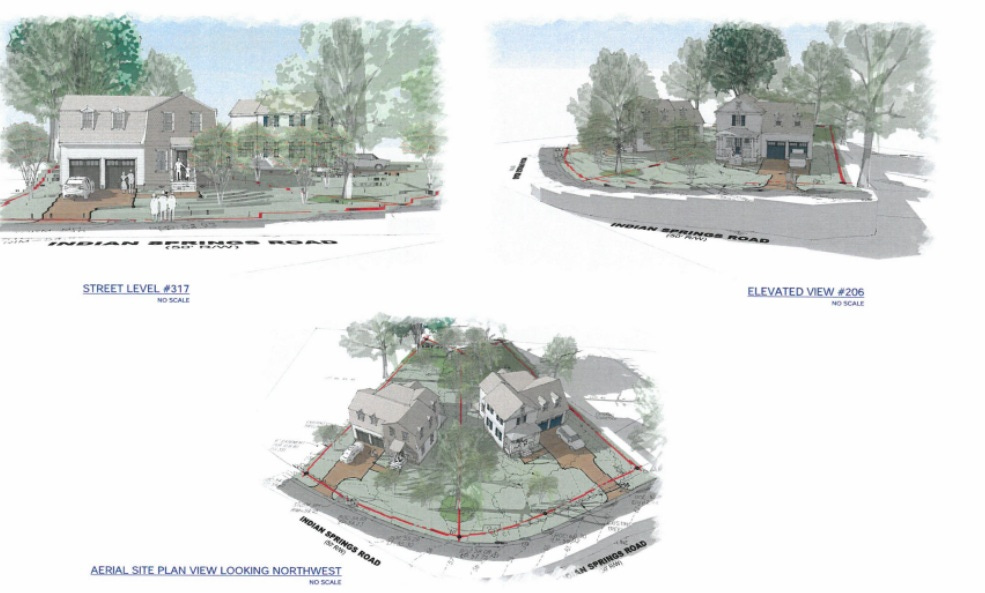
The board voted in October to deny the application from the developer, 206 and 317 Indian Springs Rd LLC, for two single family homes in the neighborhood. The applicant had repeatedly made changes to the design over three different meetings since March to comply with the board’s concerns.
The plans call for two homes with four bedrooms and four bathrooms each to be constructed at 206 and 317 Indian Springs Rd. The landowner already has one home in the neighborhood rented to college students.
The board did not issue a collective reasoning for its decision, but several members said they were swayed by strong opposition from residents who say there are too many homes in the area already rented by college students.
Planning and Codes Compliance Director Tevya Griffin and City Attorney Christina Shelton, responding to questions from council members, said the architectural review board was limited to making sure exterior designs were compliant, not deciding on land use or codes compliance.
City council had the option to approve the board decision, overturn it, or modify it.
Mayor Douglas G. Pons was critical of the review board’s decision making, adding “I have no faith that if we send it back to (the board) that the decision would be different.” The developer will still have to meet code requirements to build the homes.
Had the council not reversed the board, the landowner’s next step could have been to file a suit in court, which could have cost the city money for legal expenses on a case it would have probably lost on legal grounds, Dent said.
A large group of Indian Springs residents turned out for the meeting, and 16 of them spoke out against the project in a public hearing that lasted an hour and 17 minutes. They said William & Mary’s inability to provide adequate housing for its students had led absentee landlords to buy homes in Indian Springs to house college students.
Residents said some students littered the neighborhood and took up street parking, changing the character of what they said had been a diverse, close-knit residential neighborhood.
Council members were sympathetic.
“I see my friends and my neighbors here and I see their concern,” said Council Member Stacy Kern-Scheerer. “In so many ways I want to do what the room wants me to do and allow the (architectural board) decision to stand, because I know that it would provide a lot of relief to people that I care about and that I respect very much. But it’s clear to me that that would require me to stretch the law beyond recognition.”
Ramsey, who spoke via Zoom because she was out of town, said she would abstain because “(city council) members are bound to follow the law, however, I cannot support something that has created circumstances that I feel are contrary to the best interest of this community.”
City council members said the city was exploring changes to codes that would help historic neighborhoods keep their residential character.
“We are looking at various options and hope to make some revisions in the future and that is one thing that I will work for,” Ramsey added.
Former school critic named chair of York County school board


It’s been a philosophical journey for York County’s District 2 representative Zoran Pajevic, who was elected chair of the school board Monday.
Pajevic succeeded District 3 Representative Kimberly S. Goodwin.
The transition underscored how the two solidified their relationship with the rest of the school board since being elected on promises to shake up the school system and make it accountable to parents.
After a rocky start, the board members have settled in as a cohesive group, and board members praised Goodwin Monday for her leadership.
James Richardson of District 4 was re-elected as vice chair. Both men were elected on a 4-0 vote; District 5 Representative Lynda J. Fairman was absent from the organizational meeting Monday night.
Fairman was part of s group of three Republican-backed candidates, along with Pajevic and Goodwin, who were elected in November 2023 on similar platforms. As candidates, all three promised to look into the school system’s curriculum and operations. All three appeared on a conservative podcast where they said they would fire now-retired Superintendent Victor Shandor if elected.
They formed a majority to vote for Fairman as chair of the board, but that alliance was short-lived.
Fairman’s behavior toward critics and Shandor became disruptive, Goodwin said, and she joined Kennedy and District 1 representative Mark J. Shafer to vote Fairman out as chair four months into the latter’s term.
Eight months after that, Pajevic joined a four-member majority to temporarily strip Fairman of her committee assignments because of what they said was her behavior.
Since that time the school board has settled into a more typical business routine, and the school system remains one of the top performing school systems in Virginia.
State Headlines
What to watch as Virginia’s 2026 General Assembly returns to Richmond
Debate over social studies testing delays Virginia accountability decision
U.S. House approves funding for 2 nuclear research projects with ties to Southwest Virginia
Passings