


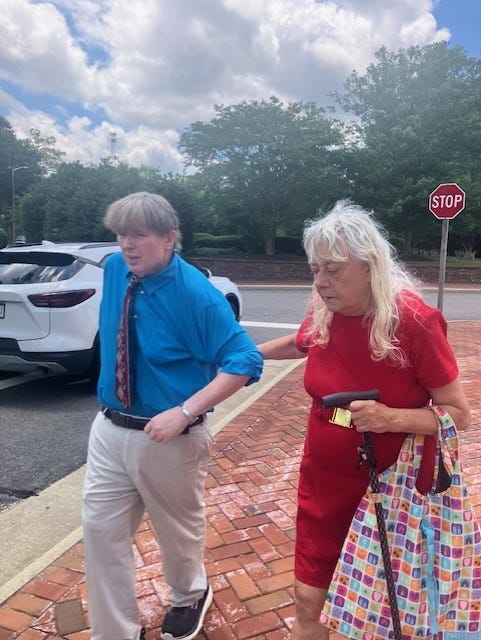
Anni K. Daly is scheduled to be evicted within eight days from the townhome where she lived 22 years.
The decisions she made to get to that point are a warning to senior citizens – and those who care for them – to make sure they are getting competent advice before making decisions about selling a home or other key financial and legal matters, social service workers told us.
Daly, 62, moved here decades ago from Denmark for a marriage that ended in divorce.
She bought a townhome at Jamestown 1607 in 2004 while she worked as a pharmacy technician, and served on the community’s homeowners association for years, according to testimony four of her neighbors and friends filed with the Williamsburg-James City County General District Court.
Those same statements said Daly appeared to be losing her cognitive abilities several years ago after losing her job. She wound up selling her town home in February 2025 at a price that was about a third of its assessed value at the time, and one third less than she originally paid, according to James City County land records.
On Monday, a Williamsburg-James City County General District Court judge approved a request from the owner of the investment company that now owns the home to evict.Daly. Presiding Judge Matthew D. Danielson told Daly he had to order her eviction within 10 days because she had no lease, and didn’t own the home.
The attorney for Corey Fenton, principal of Fenton Investment Group, told the judge Fenton was worried about the deteriorating condition of the house.
In February 2025 Daly sold her townhouse, which she had purchased for $96,000 in 2004, to Fenton Investment Group for $64,000. The home’s assessed value at the time was $173,000, according to county land records.
Prior to closing the deal, in April 2024, Daly signed a land sales contract with Fenton which stated “seller shall remain on the property and shall maintain said property in its current condition until further Agreement between the parties.”
There does not appear to have been a life estate document that would have given Daly the right to remain in the home, or a lease, and the sale was not set up as a reverse mortgage.
The land sale contract said the buyer would pay off the remaining mortgage and second mortgage — totaling $64,000 — as payment for the sale, with no additional payment stipulated to Daly.
Daly, who had no legal representation in court Monday, did not introduce that agreement as a mitigating factor. Fenton’s attorney did not bring it up.
Daly said she thought she would be allowed to remain in the home. Fenton attorney Peyton Akers told the court Daly had told his client she would move to Pennsylvania after selling the townhouse.
Fenton declined to speak with us.
Liz Buckley, executive director of House of Mercy, said seniors should obtain counseling before signing complex legal agreements. Those who cannot afford professional advisors have several other resources, she said:
· Legal Aid Society of Eastern Virginia (LASEV): Provides free civil legal assistance to low-income residents and frequently handles housing, consumer fraud, and predatory lending issues.
· The Statewide Senior Legal Helpline: Run by the Virginia Poverty Law Center, this is a free, confidential helpline specifically for older Virginians (age 60+) to get legal advice and consumer protection counseling. (844-802-5910)
· Peninsula Agency on Aging (PAA): The local Area Agency on Aging can connect seniors with local legal, financial, and supportive services.
· HUD-Approved Housing Counselors: For reverse mortgages specifically, federal law requires counseling before signing. Organizations like The Up Center in Hampton Roads offer HUD-approved housing and financial counseling, often with fee waivers for financial hardships.
Barbara Watson, director of James City County’s Social Services Department, said her office deals often with senior citizens who get in trouble because they don’t seek advice before making important decisions.
Watson, who was not referring to Daly’s case and did not suggest there was any fraud involved there, warned that many local seniors are victims of fraud.
“The most prevalent source of fraud involving senior citizens in James City County is financial exploitation,” Watson said. “We are aware of several people who had to sell their homes because they were scammed out of their finances, including retirement funds. We are also aware of romance scams, and scammers getting senior citizens to deposit large amounts of money in their accounts and have them move funds, and banks reporting age 60+ customers are reporting missing funds that they did not initiate.”